Monday, July 11, 2011

July 6 - Riverboat Discovery in Fairbanks


Our adventure today was a ride on the Riverboat Discovery, a paddle wheel steamboat .  Jim made a friend last summer while he was in Mongolia who had lived in Fairbanks for several years.  She really loved the Discovery and said that she always took friends who came to town there.

The boat dock was just a few blocks from our motel and we got there early-ish.   That put us second on the boat with a full choice of seats.  Jim dragged us up to the top deck where we had a clear view in almost every direction.  We watched huge numbers of people pouring out of tour buses and into the boat.

The boat is the third incarnation of the Discovery, each getting larger to accommodate more people.  This one holds well over a thousand people and was about 2/3rds full.    The current pilot Wade,  is the grandson of the founder.  A granddaughter Madi, who was  working on  board will have her full captain’s license next year.  Another grandson was doing the video for the trip.  The widow of the founder had helped with the development of the business in many ways, including building of the first tour boat.   Her job now is to come to the shoreline of her home, dressed to the nines and wave to folks like us twice a day. She also narrates the seniors tours.
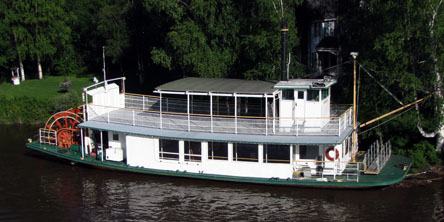
Original Discovery

We passed by several homes with planes in their yards.  There was a very small landing strip, but most planes were equipped to be float planes.


Other riverfront homes ranged from elegant to fun.
 One of the local pilots did a takeoff and landing for us along with commentary about flying.  A guy who does radio did a marvelous commentary for the entire boat tour.  The audio system was great and they often had very clear conversations with people on the shore.

The most well known and winningest driver in the Iditarod dog sled race was Susan Butcher.  She was also the first female in the race.  She died of leukemia a few years ago.  Her husband, Dave Monson still runs the Trail Breaker Kennel where they raise dogs and train them to be sled dogs.  The kennels were just a bit down river from the dock.  When we got there, we watched two 3 week old puppies being trained.  They were put into the water to learn that their handlers wouldn’t push them to do more than they were able to accomplish.  They were also teaching them to climb over logs.


They had a team of dogs tethered to an all terrain vehicle that had reinforced brakes and no engine.  On command, they flew off and went for a very fast run.  The other dogs in the kennel became very animated, wishing they could be doing the pulling.

In the last year of her life, Susan, with some help from Dave wrote a book about her dog racing experiences, focusing on the dog Granite, the runt of her litter.  Susan nursed Granite back from cancer, despites the vet’s advice, and Granite went on to lead 4 Iditarod championships.

We continued down the Chena River to where it flowed into the very large Tanana River.  It wasn’t safe to enter it since it was filled with logs and the sandbars had recently shifted.


We pulled up alongside a piece of property owned by the boat company.  A boy from the local tribe who had just graduated from high school told us about going to fish camp with his grandfather and how they used fish wheels to catch salmon.  He then gave a demonstration of dressing and drying a fish.

Fish wheel
 Some large animals came into an enclosure next to the shore.  The girl explaining them asked “what is the difference between reindeer and caribou.  Her first answer was “reindeer fly”.  Her proper answer is that reindeer are domesticated caribou.

We then disembarked and split into two groups.  Each went to a separate outdoor auditorium, eventually rotating to 3 different sites.   

At our first site, a young female from a different tribe told us about the large animals that live in the area, showing us various pelts. 

In an efficient manner, they got the roughly 400 of us to move to the next seating area.  The guy who told us about fish camp and the gal who talked about animals combined to teach us about various types of early housing.

One more mass move, this time to the place where the two young folks explained traditional costumes.


We then had about a half hour to explore things on our own.  The best place was the sled dog area.  A young woman who was with Dave’s kennels answered questions about the dogs.  She expects to be driving a team in the 2013 Iditarod.  The young dogs ran around a big enclosure, sometimes stopping to greet tourists.

They had a garden showing the effects of 24 hours of sunlight.  The cabbage was especially impressive.  We saw elsewhere, that an Alaskan cabbage last year grew to over 120 pounds.

On our way back, we saw a river otter slipping over a log in the river.  He was only visible  for a few seconds.  Jim was lucky to have been scanning the area with his camera.

To help prevent problems, the riverboat company traps logs that are floating down the river, then releases them after the afternoon boat returns to dock.  They only have 2 sailings a day.

We had lunch at the Pump House Restaurant, a place we had seen from our boat trip.  It had been part of the mining effort up the adjacent Cripple Creek.  They used a lot of old equipment in the place’s decor.  We ate outdoors where Ardith had a big burger and Jim a chicken BBQ sandwich.  The food was good, but not exceptional.


Sunday, July 10, 2011

July 5 Fairbanks


After a typical “free” hotel breakfast, we headed to the University of Alaska at Fairbanks campus.  Our first destination there was the Georgeson Botanical Gardens.  These were run by the agriculture school and were there for experimentation as well as beauty.  One experiment was to test a practice used by many farmers of heating irrigation water before applying it to crops.  Last year’s tests on tomatoes failed to show a difference.  This year, they are testing beans which are known to be very sensitive to cold soil.

They had an herb garden that had over a dozen kinds of mints growing.  Jim took tiny samples from a few of them.  He found that the Macho variety was quite powerful, but really loved banana mint.    He will look for those for his garden.

The children’s garden was lots of fun.  Jim liked the fact that a large portion of it was based on math, designed by a math teacher who loves gardening.


They had several contemporary sculptures.  Jim enjoyed the one representing a crab.

Pollination was important and they kept several hives in 2 different styles at a reasonably safe distance from the garden.  The bees were very active, but there was plenty of nectar available and they were much more interested in that than people.

Of course, very few people would go to a botanical garden that didn’t have flowers, and this one surely did not disappoint!

The stars of the show were the peonies.  They were huge, varied and beautiful.
 
We headed downtown to explore and to find a place for lunch.  We headed toward the Ice Museum, but heard some nice jazz.  We followed our ears to the nearby park and saw that the sounds were coming from a combo from an Army band.  Their music was quite good and we stayed in Golden Heart Park and listened for the rest of the concert, about an hour.  Jim was taking some pictures while they played.  Ardith pointed to the reflection in a puddle of a monument to the first settlers in Fairbanks. 

Jim said he already had taken a picture of that, but that inspired a thought – why not get a picture of the combo reflected in that puddle.   Ardith said “that won’t work” and that was all the inspiration Jim needed.  He had to lower his camera to about an inch from the ground, but it worked.

We went to lunch at a nearby cafe where you order at a counter and then can eat outside.  Jim usually drinks a diet cola, but noticed on the signboard that they had a wide variety of Italian sodas, including several sugar-free varieties.  He decided to pass up on extra caffeine and ordered a sugar-free English toffee Italian soda.  The girl asked if he wanted whipped cream and he said “oh, sure” then watched her make it using non-diet Sprite from the fountain.  So much for sugar-free.  He enjoyed a sesame chicken salad while Ardith had a BLT.

They unloaded several tour buses within sight of where we were sitting and decided that since it was such a nice day (sunny and mid 70s – Ardith hot in long sleeves) and lots of people went toward the Ice Museum, we would skip that and drive to Pioneer Park.  This is a really fun, 44 acre city park filled with a mixture of free and inexpensive things.  We started with a train ride around the park ($1 for seniors). 

 The place where the train ride begins has some artifacts and information about the Tanana Valley Railroad.  They have restored the first engine used on the line, but they only run it a few days a year.  It was impossible to get a decent side view of the engine.

They had an old photo we both loved.

There was an area with a lot of old gold mining equipment, some displayed ascetically, using dredge buckets around a pond into which water was being sprayed through a nozzle used to wash ore.


One piece of equipment was a mill where local miners could crush their ore for free in the early 1900s.

The idea for the park came in the 1960s when urban renewal was in vogue.  There were several old houses and log cabins in downtown Fairbanks that were to be destroyed.  People pressed the government to preserve some of the city’s heritage and they were moved to the park.  The houses and cabins form a village-like setting.  Many of the places are shops, some are museums that have no fee but ask for a donation.

Jim went for the place that offers a taste of Alaska’s winters.  They advertise that you go down to 40 below zero.  They have nice warm coats, so you can play dress-up with a practical twist.  The thermometer inside the cold room actually read 50 below!  Since there is almost no humidity, it didn’t feel terribly bad.  He stayed in for about 5 minutes, but knew others were waiting for their try.

The Pioneer Museum is run by the Pioneers of Alaska.  It has a wonderful assortment of object largely from the first half of the twentieth century.


The former home of the first District Judge in town provided a nice glimpse of life that wasn’t as harsh as for many.

We both had fun playing on the Nenana, a steamboat that had plied the local waters.

A true gem is the private railroad car used by President Harding when he came to drive the golden spike commemorating the completion of the Alaska Railroad.  It even included his toilet!

Saturday, July 9, 2011

July 4 Denali to Fairbanks


We needed to get up by 5 AM because they will pick up luggage at 5:45 at our cabins.  We did most of our packing last night, so 45 minutes was enough time.  When Jim went on his hike yesterday he got his hiking boots, socks and bottoms of his pants soaked.  This came from walking extensively in sphagnum-based areas and from walking across shallow streams.  There is a drying room in the building with the showers and resource room.  Jim’s nylon pants were bone dry when he checked after 2 hours.  His boots and socks were still wet in the morning, but at least on their way to becoming dry.

When we were planning this trip, friends told us that Camp Denali was the highlight of their trip to Alaska.  When Jim made a reservation, he got the last cabin available during this time period or the one before.  (People are in groups for 3 days, 4 days or 7 days).  He was told he had 10 days to mail in the full payment of a bit over $3,000.  Being a cheapskate, Jim hesitated a lot before sending the check.  He is really glad he did it.  He understands now why it is so expensive.  Between Camp Denali and Northface lodge, they have a staff of 50 who are kept quite busy.  They need to drive 7 or 8 hours each way to get groceries.  They have 5 buses, 4 vans and several trucks and other vehicles.  They serve exquisite meals. They need to maintain a water supply that runs a few miles along with an extensive processing system.  They have lots of equipment for guests, etc.

We ate our last breakfast at Camp Denali – eggs, bacon, fresh fruit and cranberry scones that had just been baked.  There were extra ones for us to take on the return bus trip.  We climbed onto the bus ready for our long four hour trip back to the visitors’ center at the entrance to the park.

As we were driving along, coins started to fall from the storage rack above us.  It felt like pennies from heaven except these were mostly quarters.  It turned out that Jim had put his coins into a pocket in the computer bag and the zipper had opened.  As the bus bumped along the coins started to leave the bag and fall down on us.  It took a while to figure out where they were coming from.  We initially though they came from an unzipped pocket in the backpack, then thought it might be someone else’s money.

Something we noticed and knew about a few time earlier, but didn’t put in our blog is a huge black crater.  It turns out that the black is ice from the Muldrow Glacier that was filled with minerals.

This trip out of Denali was filled with sightings of animals. We saw a beaver, a brother and sister yearling moose having breakfast, and a bear who was really moving fast.  We also had to stop for 3 or 4 minutes while a moose decide to get off the road about 3 vehicles ahead of us.  It was a great way to exit Denali.


Maintaining the road in Denali National Park is a major job.  There are road crews responsible for each 30 mile section with their own equipment.

As our bus arrived and luggage was being unloaded and Jim fetching our car, Ardith noticed an older couple that met the bus and greeted the staff with hugs.  They also greeted Shelton and his wife who had ridden on the bus with us.  Ardith wondered if they were Jenna’s parents who had run Camp Denali for 35 years, but there was no chance to speak with them since they were busy getting Shelton and his wife over to the train station for their return trip to California.
After loading our car and saying goodbye to our new Denali friends, we headed out to find a place to eat lunch.  Several miles from the park entrance we found a log cabin style restaurant that specialized in pizzas.  As we entered the building that same couple was also entering.   Ardith asked if they were connected with Camp Denali and when they replied “yes” she asked if they were Jenna’s parents.  They also answered “yes” to that question.  We were so excited to meet the folks who had created such a wonderful place.  They invited us to join them for lunch and we had a wonderful time learning about how they came to create such a place.  They are such warm and friendly people.  They were delighted to hear that we had such an outstanding time at Camp Denali and that we thought it was so well run.  Jim loved his fried ravioli and Ardith enjoyed a Cabin Fever pizza with Canadian bacon and pineapple.

We headed to Fairbanks, our next stop. We are staying in the Alpine Lodge which turns out to be very near the paddlewheel boat we plan to ride while in Fairbanks. The lodge is very big and looks as though it might be a place used by cruise lines for passengers who are on the bus or train portions of their tours.  However, we saw very few people there in our 3 nights.  There is a parking lot adjacent to the Alpine where 11 buses belonging to the Royal Caribbean Line came and went.  The lodge is across the road from the airport, but there are few flights. In any case, it is very quiet and a pleasant place to stay.  The only problem is that it has internet service that is occasionally good, occasionally broken and most of the time very slow which frustrates Jim.

This being the 4th of July, people, perhaps a half a mile from the lodge, were setting off fireworks.  The problem is that the sun is up until nearly 2AM and it never gets really dark.  We could hear the noises and see puffs of smoke.  There are no municipal fireworks in most of Alaska on the 4th.